

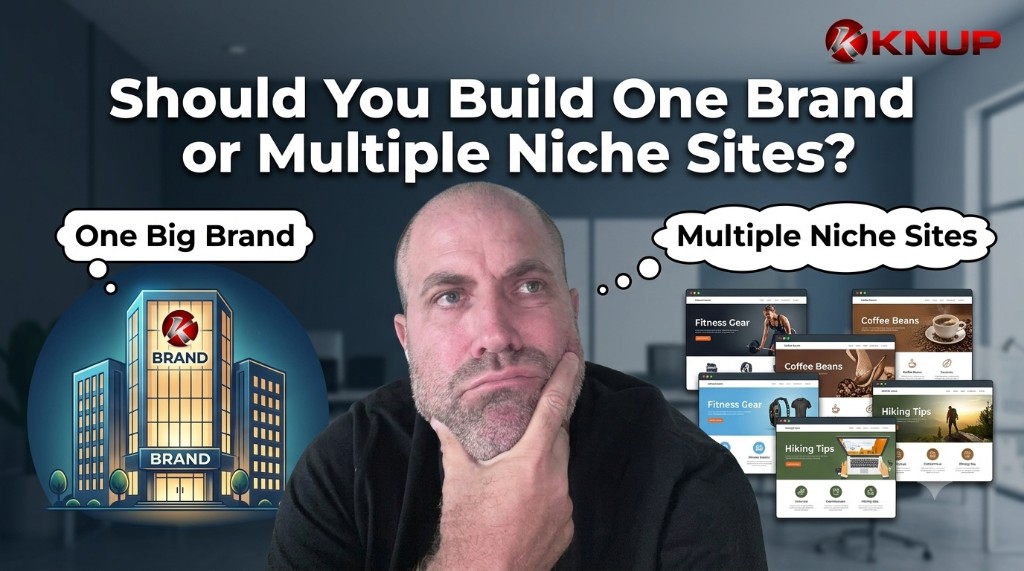
This is one of the questions I get asked the most: should I put everything under one brand, or launch a bunch of niche sites and let the winners rise?
I have lived both answers. For a long time I was deep in the multiple-brands camp. Niche domains. Separate logos. Separate logins. Separate social accounts. Separate “this one might be the big one” hopes.
Now I am firmly in the one-brand camp. Not because niche sites never work. They do. Because after enough years of branching out, consolidating into Knup has been game changing for clarity, trust, SEO, operations, and growth.
The short answer
If you are early and testing ideas, multiple niche sites can be a useful lab. If you are trying to build a real business that compounds, one strong brand usually wins after a point.
The trap is staying in testing mode forever. Launching another site feels like progress. Consolidating feels like giving something up. In practice, consolidation is often how you finally get leverage.
My multi-brand era
Sports 2.0 Network was the extreme example. We had nearly 100 writers on the agency side and used that capacity across a whole network of sports properties: flagships, niche sport sites, betting sites, team sites, a hub, shows, and social channels. On paper it looked impressive. In reality it taught me how expensive sprawl gets.
I wrote the full operator version of that story in What I Learned Running a Sports Content Network at Scale. The short version: more logos felt like growth, but fewer strong properties would have been smarter for SEO, monetization, analytics, and sanity.
Even after that, I still split my own world into Knup brands. Knup Sports. Knup Solutions. Knup Domains. Other labels for other lanes. Each one made sense in isolation. Together they diluted the one thing people needed to remember: Knup.
Getting everything under Knup and rolling has changed how easy it is to explain what I do, where to send people, what to publish, and how trust stacks over time.
Why one brand usually compounds better
1. Memory is a growth channel
People cannot recommend what they cannot remember. One clear brand name travels farther in conversations, podcasts, referrals, and search than eight almost-related names.
When someone says “talk to Ryan at Knup,” that is a clean handoff. When the answer is “depends, are you looking for the sports site, the agency, the domains thing, or the other project,” the referral dies in the hallway.
2. SEO authority likes focus
Search engines reward useful topical depth, strong internal linking, and a site that clearly stands for something. Spreading thin content across many domains often creates many weak properties instead of one authoritative home.
A niche site can rank. A network of average niche sites can also create years of maintenance with little lasting power. One brand lets related content reinforce itself: services, ventures, blog posts, resources, and proof all live in one trusted neighborhood.
3. Operations get lighter
Every extra brand means another domain renewal, hosting setup, CMS, analytics property, email list, design system, social presence, and “where did we put that login” moment.
I have spent enough time in that maze. The cost is not just money. It is attention. Attention is the real scarce resource when you are building.
4. Trust stacks in one place
Under one brand, a podcast guest, a blog reader, a domain buyer, and a service lead can all land in the same relationship graph. Your proof compounds. Case studies, content, and reputation feed each other.
Under many brands, you keep restarting trust from zero even when the same person is behind all of them.
5. Lead generation gets cleaner
Lead gen is already hard enough. I covered that in Why Lead Generation Feels Harder Than Marketing. Multiple brands make it harder because every offer needs its own path, voice, and follow-up story.
One brand lets you route people by intent without inventing a new public identity every time. Sports content, domains, systems, education, and partnerships can live as lanes inside Knup instead of competing companies in the same brain.
Why multiple niche sites are so tempting
Niche sites feel smart for good reasons:
- Exact-match keywords look easier to rank
- A narrow audience feels simpler to speak to
- You can test ideas without “polluting” the main brand
- A winning niche site can be sold on its own
- Launching something new is exciting
Those are real advantages. The problem is when the portfolio becomes the strategy. You wake up with twelve half-built properties and no flagship that people actually know.
When multiple niche sites still make sense
I am not anti niche site. I am anti accidental empire.
Multiple sites can be the right move when:
- The audiences truly conflict. If one offer would confuse or damage the other, separation can protect both.
- You are running a deliberate SEO land-grab. Some operators build topical sites as assets with clear monetization and exit plans.
- You are testing before committing the main brand. A short experiment is fine. An abandoned graveyard of experiments is not.
- The business model needs independence. A product you may sell, franchise, or partner differently can deserve its own domain.
- Local or category trust requires it. A city brand, team brand, or highly regulated niche sometimes needs its own front door.
Even then, set a rule: every niche site needs an owner, a purpose, a monetization path, and a review date. If it cannot earn its place, consolidate or kill it.
The hidden costs of sprawl
- Design and messaging drift until nothing feels related
- Analytics become hard to compare honestly
- Content quality drops because attention is split
- Social channels stay weak because none get consistent love
- Email lists never reach critical mass
- Partners ask which brand to feature
- You spend more time maintaining than building
Sports 2.0 showed me the extreme version of that tax. The Knup sub-brand era showed me the milder version still had the same disease. Different symptoms. Same diagnosis: too many public identities for one operator.
What changed when I consolidated into Knup
Rolling into Knup did not mean deleting every project. It meant making Knup the center of gravity.
Ventures still exist. Sports media still exists. Domains still exist. Systems work still exists. But the public story got simpler: this is Knup. These are the lanes. This is how to work with me.
That simplicity shows up everywhere:
- One primary domain people can remember
- One place for content that builds authority
- One ecosystem page that explains the map
- Cleaner discovery paths for services and domains
- Less explaining, more doing
If you want the naming side of that decision, I wrote a practical companion in How to Pick a Domain Name for a New Business. A weak name multiplies the pain of a multi-brand strategy. A strong one makes consolidation feel obvious.
A simple decision framework
Before you launch another niche site, ask:
- Can this live as a page, category, or venture under the main brand?
- Would a stranger remember this name after hearing it once?
- Do I have the capacity to keep this property useful for 12 months?
- Is the audience different enough that the main brand would confuse them?
- Am I launching this because it is strategic, or because a new logo feels productive?
- If this works, will I wish the authority had been building on the main domain the whole time?
If most answers point back to the main brand, do not launch the niche site. Build the lane inside the brand instead.
How to consolidate without losing what worked
Consolidation does not have to be a messy deletion spree.
- Pick the brand that already carries the most trust and memory
- Move the best content and offers under that roof
- Redirect old URLs carefully so SEO equity follows
- Keep true ventures visible as named projects when useful
- Retire the weak logos and thin sites without nostalgia
- Update email, social, and sales language to one primary name
This is also where systems matter. If your stack is already heavy, adding more properties only multiplies the pain. That is part of why I moved away from bloated website setups in I'm Done With WordPress, and why Built by Knup focuses on cleaner systems under one brand.
One brand does not mean one offer
This is the part people misunderstand. One brand is not one product. Apple is one brand with many products. Amazon is one brand with many businesses. Knup can cover sports, education, domains, media, real estate, and systems without needing a different public company name for each lane.
The brand is the trust container. The offers are the doors inside it. That structure is easier to grow than a street of unrelated storefronts with the same owner behind them.
My recommendation
If you are a founder, operator, creator, or agency owner trying to build something that lasts:
- Use niche sites sparingly and on purpose
- Default to one brand once you know what you are building
- Put related authority on the same domain whenever you can
- Treat consolidation as a growth move, not a retreat
I went down the multiple-brands path many times. Sports 2.0 was the extreme. The Knup sub-brands were the quieter version. Getting to one primary brand and rolling has been one of the best operating decisions I have made.
Clear branding also makes pricing easier. If you are still undervaluing the work because the offer feels fuzzy, read How to Price Your Services Without Undervaluing Yourself.
And if you are simplifying brands because you want a life that can move, the next layer is in What We're Changing So We Can Work From Anywhere. If the domain pile itself is the clutter, read The Real Cost of Owning Too Many Domains.
Need a cleaner brand home or a stronger domain?
If you are consolidating, start with the right brand foundation. Explore the Knup domain portfolio, or start a Built discovery if you want help designing the system under one roof.