
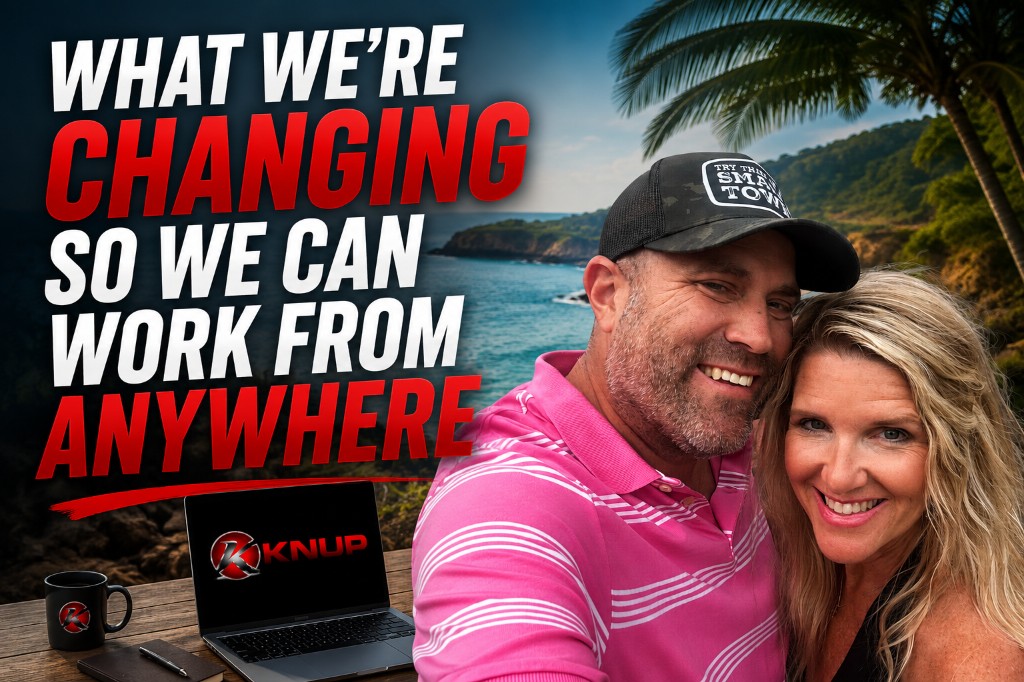
It is almost August. We are aiming to be without a permanent home starting April 1. That date feels close and far at the same time.
Close because the calendar is real. Far because the work is not packing a suitcase. The work is changing almost everything around the suitcase: the house full of stuff, the office habits, the businesses, the family rhythms, and the systems that keep money and clients moving when we are not standing in one zip code.
This is not a retirement story. It is a location-independence story. I have written about that longer-term vision on the About page. This post is the practical layer: what we are already changing so the lifestyle can actually work.
We are practicing the lifestyle before we live it
The biggest mindset shift for me has been simple: act like I do not have an office anymore.
Laptop only. Suitcase and backpack, even while we are still at home. Working remote more on purpose. If a task needs a desk full of cables, printers, and “I will grab that from the other room,” it is a clue that the setup is still tied to a building.
Visualization is not magic. It is rehearsal. If I cannot run a normal workday from a laptop on the kitchen table, I will not magically become location-independent on April 1. The practice has to come first.
1. Getting rid of the stuff
We have already started clearing weight out of the house.
- Bulk sports cards and collections that made sense in a home base and make zero sense on the road
- Extra clothes we never wear
- Big items we can sell
- Facebook Marketplace runs that feel boring and strangely freeing
Stuff is not just physical. It is decision debt. Every unused item is a tiny reminder that our life is still configured for staying put.
Decluttering is emotional too. Some things are easy to sell. Some things make you pause. The rule we keep coming back to is not “own nothing.” It is “own what can travel with us in meaning, money, or usefulness.” Memories can live in photos. Inventory that needs a spare bedroom cannot.
2. Shrinking the work kit to what fits in a bag
My personal test is getting brutal: if it does not fit in a backpack and a suitcase, why do I need it for work?
That means:
- One primary laptop
- Reliable headphones and a simple mic setup
- Cloud access to files, passwords, and docs
- A phone hotspot plan for bad wifi days
- Fewer devices, fewer chargers, fewer “just in case” gadgets
When something breaks on the road, we restock through Amazon instead of building a second office in a suitcase. Amazon Prime is the membership that makes that boring and fast — batteries, cables, packing cubes, the unsexy stuff that keeps work moving.
This also connects to the business stack. Bloated websites, local-only tools, and office-dependent processes fight travel. Cleaner systems travel better. That is part of why I have been pushing simpler builds and away from heavy WordPress sprawl in posts like I'm Done With WordPress.
3. Making the businesses travel-ready
The lifestyle only works if the businesses can move with us. So we are ramping the virtual and digital sides harder on purpose.
That includes:
- Offers that can be delivered remotely
- Content and products that do not require a local office
- Client communication that works across time zones
- Less dependency on in-person meetings for progress
- Stronger online discovery paths so opportunity is not only local
Location independence is not “work from a beach.” It is “the business still runs when the beach is closed, the wifi is weak, and school is happening at the same table.”
4. Building recurring revenue and clearer offers
Travel gets stressful fast if every month depends on landing a brand-new project under pressure.
So one of the real changes is financial structure: more predictable income where we can create it. Retainers. Memberships. Subscriptions. Digital products. Hosting and systems work that continues without constant reinvention.
Clear packaging helps too. Vague custom work is harder to sell and deliver while moving. Stronger offers and healthier pricing matter more when your calendar is already full of logistics. That is why recent thinking around How to Price Your Services Without Undervaluing Yourself is not separate from the nomad plan. Underpricing creates fragile businesses. Fragile businesses do not travel well.
5. One brand, less sprawl
We are also simplifying identity.
Multiple brands, niche sites, and side projects feel exciting when you have a home office and spare rooms. They feel heavy when every login, logo, and inbox has to come with you mentally.
Consolidating under Knup has already been a game changer for clarity. I wrote about that shift in Should You Build One Brand or Multiple Niche Sites. For travel, the benefit is even more obvious: one primary brand people can remember, one ecosystem to point to, fewer public identities to maintain from a laptop in a new city.
6. Documenting systems so the founder is not the bottleneck
If every answer lives in my head, we are not location independent. We are just relocating the bottleneck.
So the changes include:
- Writing down processes that used to live as “just ask Ryan”
- Using shared docs, CRM notes, and clear ownership
- Automating the repetitive handoffs where it makes sense
- Building SOPs for onboarding, publishing, support, and billing
- Making sure someone else can move a task forward without waiting on my wifi
This is the unsexy part of digital nomad life. Beaches do not replace checklists. Checklists make beaches possible.
7. Lead generation and follow-up that do not need a local network
When you leave a permanent home base, you also leave some of the casual local opportunity that used to find you.
That means the online lead path has to get stronger: website clarity, useful content, email capture, CRM follow-up, and partnerships that do not depend on being in the same room. I have been writing through that stack lately in Why Lead Generation Feels Harder Than Marketing and How to Follow Up With Leads Without Being Annoying.
If the pipeline only works when I am networking in person every week, April 1 will feel like a cliff. If the pipeline can create conversations from content and systems, travel becomes an operating mode instead of a business risk.
8. Family logistics are part of the business plan
This is not a solo backpacker fantasy. Sarah, Drew, Bryce, and Alyssa are in this with me. That changes everything.
We have to think about:
- School and learning on the move, including the world around Ideal Homeschool
- Rhythms that protect family time and work blocks
- Health, insurance, and mail that do not assume one address forever
- What “home” means when home is people and routines more than square footage
- How to keep the kids’ lives rich without needing a permanent storage unit of stuff
Digital nomad content online often skips this layer. With kids, the plan has to include boredom, laundry, quiet work windows, and the reality that somebody always needs a snack during your most important call.
9. Money, admin, and adulting from anywhere
The less glamorous list still matters:
- Banking and bookkeeping that are fully online
- A mail solution that is not “the pile on the counter”
- Subscriptions audited so we are not paying for home-base tools we no longer use
- Passwords, 2FA, and device security that travel well
- Backups for files and important documents
- A clear monthly budget that includes travel variability
Freedom without admin is just delayed chaos. We are trying to clean that up before the chaos has a passport stamp.
10. Fewer commitments that require a fixed address
Some things only work if you stay put: oversized inventory businesses, office-dependent delivery, local-only calendars packed with standing meetings, and projects that need you on-site every week.
So we are asking harder questions before saying yes:
- Can this be done remotely?
- Does this create recurring value or one-off stress?
- Will this still make sense if we are in another state or country next month?
- Does this need a garage, a warehouse, or a spare room?
Saying no is part of becoming portable.
What “work from anywhere” actually means for us
It does not mean never working. It means the work is designed to move.
It does not mean abandoning Central Florida relationships. It means those relationships are not the only way the businesses survive.
It does not mean a perfect aesthetic Instagram life. It means fewer anchors that keep us from choosing experiences together.
The target is a slower, more flexible lifestyle where the portfolio supports the family instead of trapping it. Recurring revenue. Documented systems. Remote delivery. Owned platforms. One clearer brand. Less stuff. More life.
The checklist we are living through now
- Sell or donate what will not travel
- Practice laptop-only workdays at home
- Pack and live from bag constraints before we have to
- Push digital offers and remote delivery harder
- Strengthen recurring revenue where possible
- Keep consolidating brands and tools
- Document processes that currently live in one person’s head
- Improve online lead flow and follow-up
- Align family schooling and daily rhythms for mobility
- Clean up admin, mail, banking, and subscriptions
That is a lot. It should be a lot. Going without a permanent home is not a weekend project. It is a full redesign of how we live and work.
Final thoughts
April 1 is the date. The changes are the real story.
We are not waiting until the lease ends to become portable people. We are becoming portable people so the date is possible. Getting rid of cards, clothes, and heavy items. Working like the office is already gone. Building the digital businesses louder. Making systems and revenue travel-ready.
If you are chasing the same kind of freedom, start earlier than feels necessary. The trip is the easy headline. The redesign underneath it is the work. For the money, subscription, membership, and calendar reset, use Do a Life Audit Before You Go Location Independent. For how we are soaking up Orlando before we leave — including annual Disney passes — read Why We Got Annual Disney Passes Before Leaving Orlando. For the Friday version of what intentional living looks like in practice, see 7 Decisions That Made Our Life Feel Intentional.
Need a business that can move with you?
Whether you are simplifying the foundation or strengthening growth systems for remote delivery, that is the kind of work we do through Built by Knup.