

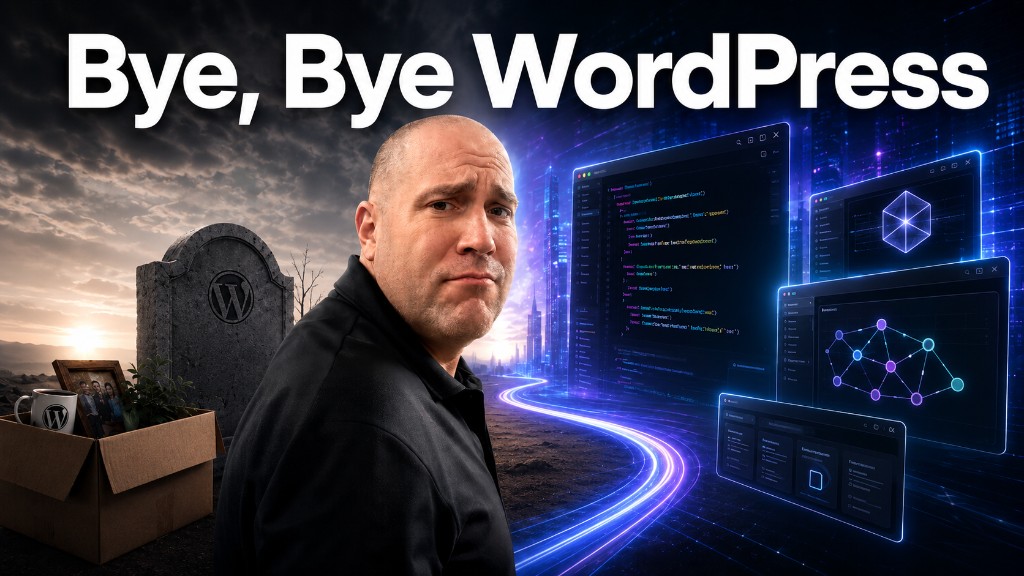
I never thought I would write this post, but here we are: I am done with WordPress as the center of my web business.
I have spent more than 15 years building websites and projects on WordPress. Client work. Media sites. Niche projects. Experiments. I made good money with it and learned a lot through it. So this is not a hit piece. This is a real transition story from someone who used WordPress heavily for a long time.
What changed is simple: AI-assisted development changed the speed and economics of custom builds. Tools like Cursor and other vibe coding workflows made it realistic to move faster with lean code, tighter systems, and less plugin-heavy overhead.
The old model worked for a long time
For years, WordPress was the obvious move. It gave me:
fast launch speed for basic projects,
a huge ecosystem of plugins and themes,
easy content editing for teams,
and a wide talent pool when I needed support.
If you were building in 2010, 2015, even 2020, that stack made sense for most business owners. I built a lot of value with it.
So why move away now?
In one sentence: the trade-offs are now too expensive for what I want Built by Knup to deliver.
I am seeing more bloat, more maintenance drag, and more stack complexity just to keep simple things working cleanly. The deeper I got into conversion systems, lead routing, and automation, the more I felt like I was fighting tooling decisions instead of shipping outcomes.
Reason 1. Plugin bloat became normal
This is the big one. Most WordPress builds slowly turn into plugin stacks. Need speed? Add a plugin. Need forms? Add a plugin. Need schema? Add a plugin. Need redirects? Add a plugin. Need security hardening? Add a plugin.
None of those are bad on their own. The problem is what happens over time: update conflicts, duplicated functionality, inconsistent settings, and random breakage after what should be harmless updates.
When you run one site, that is annoying. When you run many projects, that is expensive.
Reason 2. Performance work became patchwork
I care a lot about speed, clean UX, and direct conversion paths. In WordPress, performance tuning often feels like chasing symptoms instead of controlling the source. Cache layers, image optimization plugins, script loading plugins, ad/plugin conflicts. You can get good outcomes, but it takes too much tuning and ongoing babysitting.
I would rather run lean pages with exactly what we need and nothing else.
Reason 3. AI changed how fast I can build
This is the biggest shift in my day-to-day workflow. AI coding tools moved me from "configure a stack" to "ship the exact system."
With Cursor and modern AI workflows, I can:
generate or refactor components faster,
build purpose-driven pages instead of template wrestling,
wire custom business logic directly,
and iterate quickly without forcing everything through plugin constraints.
If you have not tried this flow seriously yet, start with /go/cursor and test it on one small project. The speed difference is real.
Reason 4. Built by Knup is about systems, not installs
Built by Knup is not supposed to be "we install a website and good luck." It is supposed to be a full system: page flow, lead capture, CRM routing, follow-up logic, and reporting loops.
That system-first model is easier when the codebase is controlled and intentional. It also pairs better with tools like ActiveCampaign and operations workflows that tie traffic to revenue.
If you read my article on why traffic without lead flow fails, this is the same idea. Content is one piece. The system behind the content is what moves business results.
Built by Knup is system first
We build websites, funnels, CRM paths, and automation around outcomes, not around plugin stacks.
A practical case study from my own shift
Here is what this migration looks like in real life, not theory.
Then: I had many projects centered on WordPress conventions. Speed to launch was fine, but every quarter included plugin updates, maintenance checks, and quality drift between sites.
Now: I am moving core projects into leaner structures with tighter control over templates, styles, route handling, and conversion logic. I can ship edits faster, debug faster, and make system-level changes with fewer moving parts.
The outcome is not just technical. It changes operating rhythm:
less maintenance noise,
faster launch cycles,
clearer ownership of business logic,
better consistency across brands.
What I am migrating next
I still have 4 to 5 projects left to migrate personally. I am not pretending this happens overnight. But the direction is set. It is only a matter of time before I am fully off WordPress for my core operating stack.
I am taking a staged approach:
Stage 1: Migrate high-impact pages and lead paths first.
Stage 2: Move content libraries and shared components.
Stage 3: Consolidate analytics, routing, and automation across projects.
Stage 4: Retire old WP dependencies and maintenance overhead.
This is the same process I recommend to clients. You do not need a dramatic one-day rebuild. You need a clear migration roadmap with business priorities attached.
Who should still use WordPress?
To be clear: WordPress is still fine for many people.
If you need a simple content site, have a familiar team, and your stack is stable, WP can still work. This post is not saying WordPress is dead. It is saying WordPress is no longer the center of how I want to build and scale.
My decision is based on my goals: speed, system control, AI-assisted development, and cleaner long-term operations across multiple brands.
What this means for Built by Knup clients
It means we are designing around outcomes first, platform second.
If a client needs a non-WP build, we are already there. If a client needs to keep part of a WP setup temporarily, we can bridge that while migrating high-value flows first.
It also means more practical recommendations on the operations layer: social scheduling with Metricool, email and CRM flow with ActiveCampaign, and focused conversion paths from page to action.
If you are planning your own stack shift, you can also browse tools on my resources page and start testing one piece at a time.
The emotional side of this decision
I will be honest: this move was not easy. WordPress has been part of my career for over 15 years. A lot of wins came through that chapter.
But there is a difference between loyalty and alignment. I am building in a different era now. AI has changed what is possible for small teams and solo operators. The cost of staying with old habits can be higher than the cost of changing.
I did not think I would pull the trigger this hard. But once I saw what cleaner, AI-assisted workflows could do for speed and control, I could not justify staying centered on WordPress.
Final take
I am not anti-WordPress. I am pro-forward progress.
For my business, my projects, and the direction of Built by Knup, the best move is clear: leaner systems, smarter tooling, and less platform drag. That is the future I am building toward. The same ownership thinking shows up in why I built our own member portal instead of renting another course platform and in moving backup-only git remotes from GitLab to Cursor Origin.
If you are in a similar spot and wondering whether to migrate, start with one high-value path first. You do not need to migrate everything today. You just need to begin intentionally.
Thinking about your own WordPress migration?
I can help you map a practical move from plugin-heavy setup to a cleaner build and conversion system, without breaking your business in the process.