
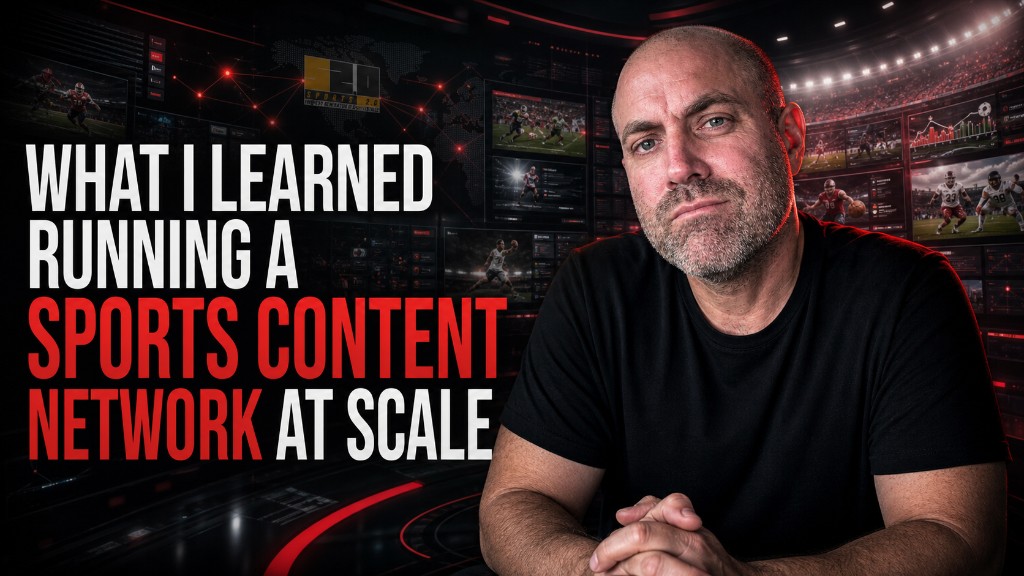
Publishing a lot of sports content is not the hard part. Keeping it useful, ranked, on brand, and somehow monetized while dozens of writers move at once is the hard part.
From about 2022 through 2024, I ran the Sports 2.0 Network as an internal content network built on top of our agency bench. At the peak of that era, our content agency side had nearly 100 writers. Sports 2.0 was how we cross-utilized that capacity on owned sites instead of only shipping client work.
This is not a sales story. It is an operator story. What worked. What broke. What I would do again. And what I would never rebuild the same way. For the venture archive page with the full network footprint, start at Sports 2.0 Network.
How Sports 2.0 came about
Knup Solutions was already a real sports and iGaming content agency before Sports 2.0 became a network. Client demand kept growing. My brother came in early to help with writing. Then editors. Then more writers. By the early 2020s we were producing a massive volume of human-written sports content every day.
The problem with that kind of bench is simple. If you only use writers for client deadlines, you get paid for throughput and you learn almost nothing about owning the full stack: SEO, brand voice across sites, conversion paths, social distribution, and the quiet work of keeping a network alive when nobody is begging for the next article.
So we built Sports 2.0 as the internal league. Same people. Same sports knowledge. Different responsibility. Publish across our own properties, test formats, train newer writers in live environments, and create a hub that made the whole thing feel like one ecosystem instead of a pile of orphan WordPress installs.
What the network looked like
At the snapshot that still defines that era for me, Sports 2.0 was roughly:
- 17 content websites with traffic, authority, and rankings
- 3 bonus properties around betting commerce and community
- About 19 social channels with more than 70,000 combined followers
- Email lists totaling more than 16,000 targeted opt-ins
- Multiple shows across sports interviews, bets, and niche leagues
- Nearly 700,000 organic sessions across the network in a 12-month window, with no paid traffic
The structure mattered as much as the count. We ran flagship sites like Knup Sports and USA Wager, a network hub at Sports20.com that pulled fresh articles in automatically, niche sport sites for baseball, basketball, football, soccer, MMA, hockey, and esports, betting-focused properties, and team or city sites for passionate local audiences.
Knup Sports was the staple. Deep content archive. Stronger domain history. Broad coverage. USA Wager was built for the U.S. betting boom. Sports20.com was the feed hub. The niche and team sites were topical or local bets that could stand alone or eventually consolidate into a stronger flagship.
Lesson 1: Scale starts with systems, not more writers
Hiring more writers feels like progress. It is not progress by itself. At scale, every new writer multiplies your need for briefs, examples, editors, naming rules, image templates, publishing checklists, and someone who will say no.
The networks that survive are the ones that treat content like an assembly line with standards. Topic selection. Source rules. Title patterns. Internal linking habits. Affiliate disclosure language. “Done” definitions. Without that, you do not have a network. You have chaos with logos.
What helped us most was boring documentation. Same theme families where we could. Shared Canva templates by brand. Clear sport ownership. A hub that showed what published across the network. Google Analytics with author views so volume did not hide who was actually shipping.
Lesson 2: Quality control is the real bottleneck
At 10 writers, you can feel quality with your gut. At nearly 100, your gut is a liability. You need layers.
We learned to separate drafting from editing hard. Writers drafted. Editors protected the brand. Templates reduced the chance of missing basics. Sample “good” and “not good” pieces trained people faster than pep talks. And we accepted a truth operators hate: some writers never become network writers. Volume talent and brand talent are different skills.
The fastest way to wreck SEO and trust is to publish thin takes at industrial speed. Sports audiences forgive opinion. They do not forgive lazy facts, recycled intros, or articles that exist only to hit a quota.
Lesson 3: SEO rewards focus more than site count
A network looks impressive on a slide. Search engines care about topical clarity, useful pages, and whether users stick around.
Some of our niche sites ranked well because they stayed in their lane. Baseball Spotlight and Basketball Articles had room to build topical depth. Newer sport sites with thinner archives struggled. Flagships with years of content and better domain history carried more of the traffic load. Knup Sports alone did hundreds of thousands of sessions in that 12-month window. Several smaller sites did a few hundred.
That spread taught me something I still preach: do not confuse “we launched another site” with “we built another asset.” A weak site costs hosting, attention, login fatigue, plugin updates, and editorial bandwidth. Sometimes the SEO move is consolidation, not expansion.
Lesson 4: WordPress can run a network, but it will tax you
The whole network ran on WordPress. Themes like Extra, Divi, MH Magazine, and Engine. Rank Math. Advanced Ads. SiteGround hosting. Dynadot domains. Search Console. Tag Manager on some properties. It worked. It also meant update debt, plugin conflict risk, and design inconsistency as the network grew.
Standard designs across niche sites helped. Custom everything everywhere hurt. If I were building a similar network today, I would force fewer platforms, fewer theme families, and a clearer publishing core before adding the twentieth brand. I have already written about why I moved away from WordPress-centered builds for new systems in I'm Done With WordPress. Sports 2.0 was one of the experiences that pushed me there.
Lesson 5: A hub site is useful, but it is not a business model
Sports20.com existed as the network hub. It pulled content in on a short cadence, organized by sport and author, and gave the Sports 2.0 brand a front door. That was smart for visibility and contributor showcase.
It was not, by itself, a monetization engine. Hubs are organizational tools. Money still comes from offers, ads, email, products, events, memberships, or services attached to pages people trust. If your hub only aggregates and never converts, you built a scoreboard, not a business.
Lesson 6: Traffic without conversion is an expensive hobby
This is the lesson people skip because it bruises the ego. We had real organic traffic across the network. Nearly 700,000 sessions in a year with no paid acquisition is not nothing. We also never fully monetized that traffic.
We dabbled. Sponsored posts here. A handful of affiliate signups there. Some advertising experiments. Enough to prove the pipes could make money. Not enough to call it a finished growth system. The honest purpose of Sports 2.0 for us was training the content team and owning distribution practice, not maximizing every click.
Converting sports content is hard for specific reasons:
- Readers often want the take, not your offer.
- Betting and affiliate paths need trust, compliance, and clear next steps.
- Email lists go cold if you never talk to them.
- Social followers do not equal buyers.
- Archive pages need CTAs, not just more articles.
- Team fans will argue forever and still not click an affiliate link.
If you are living that gap right now, these two posts pair well with this one: Why Your Blog Gets Traffic but No Leads and How to Monetize Traffic Spikes on Your Website.
Lesson 7: Email and community were underused gold
Across years of sites, forums, contests, and products, we had meaningful email assets and community history. Some lists were fresher. Some were older and inactive. One forum property alone had tens of thousands of topics and hundreds of thousands of posts from an earlier era of sports betting internet.
What I learned the hard way is that owned audience compounds only if you work it. Collecting emails while you publish at scale is not a strategy. Re-engagement, segmented offers, and a reason to open the next message are the strategy. Same with communities. An inactive Discord or dormant forum is inventory, not growth.
The sites that had emotional fan energy, like long-running team communities, showed how powerful belonging can be when product and content meet. I wrote more about that side of building in How to Build a Small Online Community.
Lesson 8: Shows create reach and relationships, not automatic revenue
Sports 2.0 had multiple show formats over the years. Interview shows. Bet-style clips. Niche league shows. The Knup Sports Show especially created relationships and links because guests had a reason to share episodes. That mattered.
Shows still need packaging. Show notes. Clear URLs. CTA discipline. A path from viewer to email or partner page. Otherwise you get nice conversations and weak business outcomes. If you are starting from scratch on that front, How to Start a Podcast With a Simple Setup covers the practical production side.
Lesson 9: Hiring, firing, and culture decide whether scale is survivable
Content networks fail socially before they fail technically. Missed deadlines. Silent writers. Ego fights over edits. People who only chase word count. Editors who burn out protecting the brand.
What worked for us over the long arc:
- Hire slower than the deadline panic wants.
- Pay fair enough that good people stay.
- Give clear ownership by sport or site.
- Promote editors who protect standards, not just prolific writers.
- Cut faster when quality and reliability never improve.
- Keep family and core teammates close when trust is already proven.
I am better at building systems than endlessly managing people. Sports 2.0 made that clear. The agency years made that clear. That self-knowledge later shaped why I moved toward products and infrastructure instead of forever scaling headcount.
Lesson 10: AI changed the economics, but judgment still wins
By 2023, it was obvious the content market was shifting. Client budgets, quality expectations, and speed all moved. We acquired and built into Coded Content as an AI-powered sports content system for the parts of publishing that do not need a human drafting every paragraph from scratch.
My take is balanced on purpose. Human writers still matter for voice, original reporting, relationships, and judgment calls. AI systems matter for speed, structured sports coverage, consistency, and cost control at volume. The operators who pretend one side erased the other are usually selling something.
Sports 2.0 taught me what “at scale” feels like with humans. Coded Content is how I apply those lessons with better leverage. If you need sports content infrastructure today, start at CodedContent.ai.
Lesson 11: Consolidation is often the grown-up move
One of the smartest options for a network like ours was always consolidation. Take thinner niche sites and roll authority into a stronger flagship. Keep the brands that have emotional or commercial reasons to stand alone. Kill the rest of the login sprawl.
More logos feel like growth. Fewer strong properties often produce better SEO, clearer monetization, simpler analytics, and saner operations. If I rebuilt a sports network tomorrow, I would start with one or two flagships, maybe one true niche bet, and prove conversion before cloning the model ten times.
That same consolidation lesson now shapes how I think about the broader Knup ecosystem. I break down the one-brand versus niche-site decision in Should You Build One Brand or Multiple Niche Sites.
What I would do differently
- Pick monetization paths on day one, even if light.
- Force fewer themes and fewer plugins across the network.
- Build email capture into every high-traffic template.
- Audit conversion monthly the same way we audited publishing volume.
- Consolidate earlier instead of romanticizing site count.
- Separate “training ground content” from “money pages” more clearly.
- Treat shows and social as distribution channels with owners, not side hobbies.
Who these lessons are for
If you run affiliate or media sites, the warning is simple: traffic is not the finish line. If you are a founder building a content team, systems and editors matter more than your next hire. If you are thinking about launching your own network, start smaller than your ambition and instrument conversion early. If you already have writers and no owned lab, an internal network can train people fast, but only if someone owns quality and commercial outcomes.
Final thoughts
Sports 2.0 was never just a collection of domains. It was a pressure test for everything I believed about sports media: that volume can be built, that SEO still rewards useful archives, that writers need systems, and that monetization is a separate sport from publishing.
I am glad we built it. I am glad we learned where human scale shines and where it breaks. And I am clearer now on the split: use strong people and strong process where judgment matters, and use better infrastructure where repetition is the job. The archived venture page for Sports 2.0 Network keeps the footprint and timeline in one place.
Need sports content at scale, or a system to own your network?
Use Coded Content when you need sports publishing infrastructure. Use Built by Knup when you want help designing the sites, workflows, and conversion paths behind your own network.