
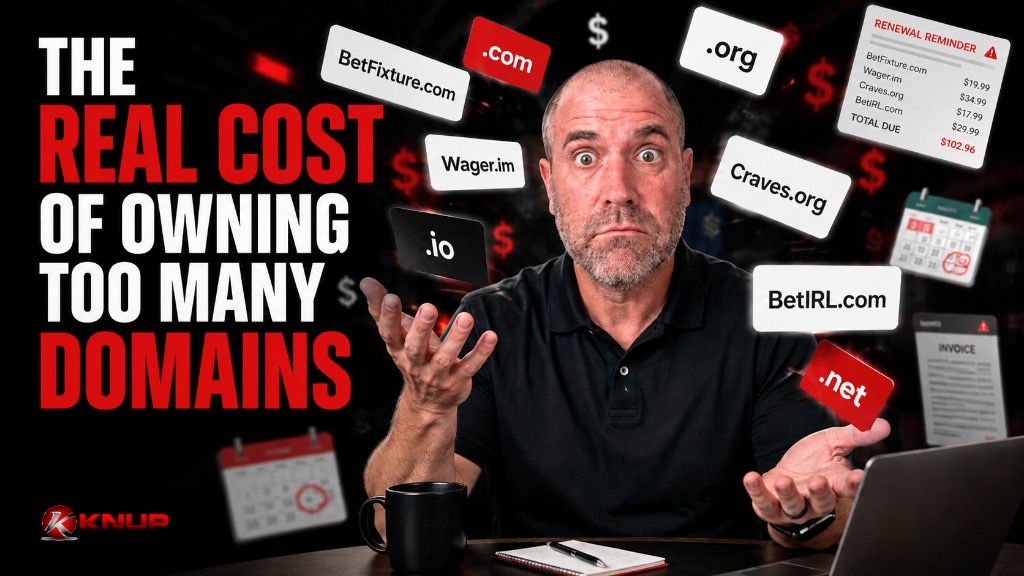
People think the cost of domains is the checkout total. It is not.
At one point I owned about 1,600 domains. I have sold some, built on some, and dropped a lot. The renewals hurt. The bigger bill was attention: names I never developed, brands I never clarified, and a portfolio that felt productive while quietly draining focus.
If you are sitting on dozens or hundreds of names “just in case,” this is the audit I wish I had run earlier.
The visible cost: renewals add up quietly
One domain is cheap. A hundred is a subscription you forgot you bought.
- Annual renewals across registrars
- Premium renewals that surprise you later
- Privacy, DNS, and email add-ons
- Transfer fees and time when you consolidate
- Expired-name panic buys at worse prices
Do the math in public with yourself. One hundred names at even modest renewal rates is real money every year — before premium TLDs, aftermarket holds, or “just one more” impulse buys. Pull a year of renewal totals. Multiply by how long you have been collecting. That number is usually enough to make people honest.
Tools and registrars matter here — I often point people to Dynadot for portfolio work — but no registrar can save you from owning names you will never use.
The invisible cost: attention and decision debt
Every unused domain is a tiny open loop.
- Should I build this?
- Should I sell this?
- Is this still a good idea?
- Did I already buy something similar?
- Why does this renewal email stress me out?
That is decision debt. It sits in the same bucket as unused subscriptions and forgotten memberships. I wrote about that broader reset in Do a Life Audit Before You Go Location Independent. Domains belong on that list. They are digital clutter with an invoice.
Attention is finite. A portfolio that needs constant justification steals energy from the few projects that could actually compound.
The brand cost: too many names, not enough identity
A fat portfolio often pairs with brand sprawl. Knup Sports. Knup Solutions. Knup Domains. Niche sites. Side projects that each needed a URL before they needed a customer.
Owning the domain feels like progress. Shipping under one clear brand is progress. That is why consolidating into Knup mattered so much, which I covered in Should You Build One Brand or Multiple Niche Sites.
Too many domains train you to start. They rarely force you to finish. The dopamine of “available” is not the same as the discipline of “launched.”
The opportunity cost: money that could have bought better names
This one stings. Spreading renewals across weak names means less capital for the few strong ones that actually matter.
I have watched people renew mediocre three-word .coms for years while avoiding the cleaner brandable they actually need. Cheap inventory feels responsible. Concentrated quality usually wins. The picking standards I use now are in How to Pick a Domain Name for a New Business.
Opportunity cost also shows up as time. Hours spent organizing spreadsheets of maybes are hours not spent selling a strong name, building a site, or talking to a real customer.
The operations cost: sprawl has logistics
More domains means more admin:
- Registrar logins and 2FA
- DNS records scattered across panels
- Email forwards you forgot existed
- SSL and hosting leftovers
- Whois / account recovery when something expires
That overhead gets worse when you are trying to become location independent. Portable life wants fewer anchors. A bloated portfolio is an anchor that renews itself every year. That connects directly to the systems work in What We're Changing So We Can Work From Anywhere.
How I got here (and what changed)
I did not set out to own 1,600 domains as a flex. I set out to catch opportunities. Sports names. Brandables. Idea insurance. “This might be a site someday.” Some of that was smart investing. A lot of it was collecting.
What changed was not a hatred of domains. I still love strong names. What changed was the scoreboard. I started asking whether a name earned its renewals through use, sale potential, or clear strategic hold — not through nostalgia.
Sold some. Built on some. Dropped many. The portfolio got healthier when it got smaller and more intentional.
What “too many” actually means
Too many is not a fixed number. It is a mismatch between ownership and intention.
You probably own too many if:
- You cannot explain why you still hold half of them
- Renewals surprise you
- You keep buying instead of building or selling
- Similar names sit unused next to each other
- The portfolio feels like identity, not inventory
A tight investor portfolio can be large on purpose. A hobby pile that you call a portfolio is different. Be honest about which one you have.
A simple domain audit
Sort every name into one bucket:
- Build: active project or clear near-term use
- Sell: strong enough for someone else, not for you
- Keep as asset: rare, brandable, or strategic hold with a reason
- Drop: no use, no buyer story, no strategic value
Rules that help:
- If you have not thought about it in 12 months, it is on probation
- If you cannot pitch it in one sentence, do not renew on autopilot
- If two names solve the same idea, keep the stronger one
- If renewing it only avoids guilt, drop it
Dropping a domain is not failure. It is rent you stopped paying on an empty lot.
Keep the ones that earn their place
I still believe in strong domains. Short. Clear. Mostly .com. Names people can say once and type right. The mistake was treating every available idea as a purchase order.
Quality over quantity. A smaller stack of names you can defend beats a museum of maybes. If you need a better primary brand name, hunt quality — do not add another weak backup.
Browse premium domains from the Knup portfolio
Looking for a stronger brand name instead of another maybe? Start with the domains hub or request a price on a specific name.
Final thoughts
The real cost of owning too many domains is not only the renewal email. It is the focus you never spent building, selling, or choosing a real brand.
Audit the portfolio. Keep what you can defend. Sell what belongs with someone else. Drop the rest. Then put the money and attention into names — and businesses — that actually move. Half-built projects are the same tax in a different folder — I wrote about that in I Have About 10 Half-Built Projects and Almost None of Them Have Launched.
Need a stronger domain — or help cleaning up the pile?
Explore the Knup portfolio, request pricing, or start domain discovery if you want a clearer brand asset instead of more inventory.