

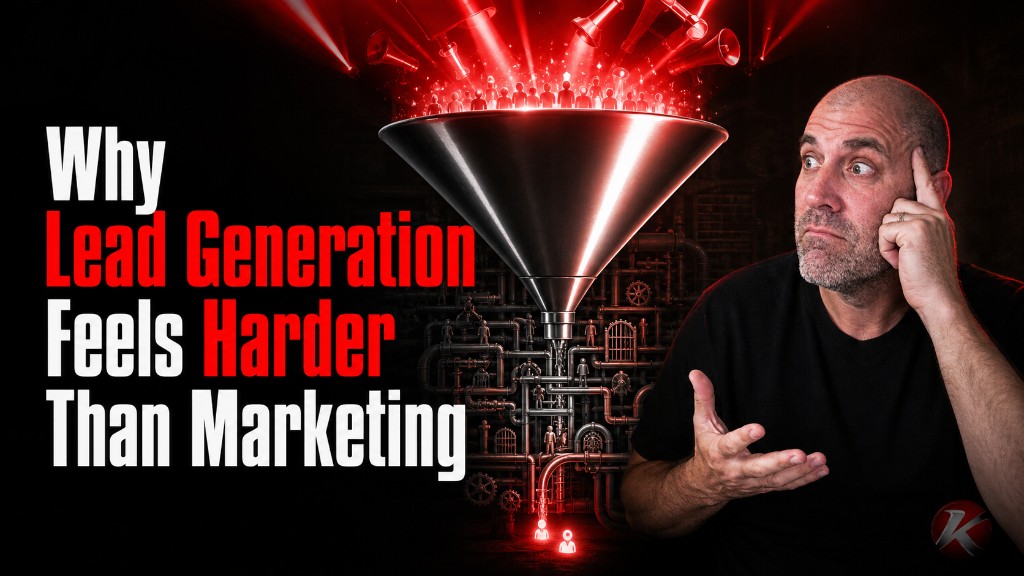
Marketing can make you feel busy and visible. You can publish a post, sponsor an event, send an email, run an ad, or hand out flyers. Lead generation asks a much harder question: did the right person actually raise a hand?
I have been thinking about that difference lately because quality lead generation feels hard right now. Not impossible. Not dead. Just harder than the simple marketing advice makes it sound.
Every business needs attention, but attention alone does not create a pipeline. A view is not a lead. A follower is not a lead. A person walking past your booth is not a lead. Even an email address is not always a useful lead if there is no need, trust, timing, or follow-up behind it.
Marketing and lead generation are not the same job
I think businesses blur these terms because marketing is easier to see. Marketing creates awareness. It puts your business in front of people and helps them understand who you are. Lead generation turns some of that attention into identifiable people you can continue helping and communicating with.
Marketing says, “We are here.” Lead generation gets someone to say, “I may need this. Tell me more.”
That second step carries more friction. The person may need to give you a name, email, phone number, details about a problem, or permission to follow up. They know a sales conversation may come next. The exchange suddenly feels more expensive, even if the form is free.
A recent reminder at an AAU tournament
We recently set up Sports Mentorship as a vendor at an AAU basketball tournament with around 420 teams. The building was full. Players, parents, coaches, and families were everywhere. On paper, that sounds like a perfect audience and a huge lead opportunity.
We had a booth. We had free raffles. We had reasons for people to stop. We could have looked at the crowd and called the marketing a success. The brand was visible in a place where our potential audience already gathered.
Yet generating real leads still felt nearly impossible.
The lesson was not that events do not work. The lesson was that proximity is not intent. Parents were watching games, managing schedules, feeding kids, finding courts, and trying to get through a long weekend. They were physically close to us without necessarily being mentally ready to think about mentorship.
That small example applies to almost every business. Website visitors are often distracted. Social followers are scrolling. Event attendees have somewhere else to be. The audience can be correct while the moment is wrong.
Why quality lead generation feels so difficult
Attention has become cheap and noisy
Businesses can create more content and reach more people than ever. AI lowered the cost of production. Social platforms made publishing immediate. Ads can place a message in front of a targeted audience within minutes.
The result is not unlimited attention. It is unlimited competition for attention. People have trained themselves to ignore most offers before they fully understand them.
People protect their information
Consumers know what happens after they enter a form. Emails arrive. Text messages start. Salespeople call. Sometimes their information seems to travel farther than expected.
Asking for contact information is asking for trust. “Join our newsletter” is rarely enough anymore. The person needs to understand exactly what they will receive and why it will make their life easier.
Most offers are too broad
“Contact us to learn more” makes the prospect do all the work. Learn more about what? What happens after contact? How much time will it take? Is this for someone like me?
A stronger offer connects to a specific problem: get a website conversion review, compare content options, receive a practical checklist, or see whether a service fits your current stage. Specificity lowers uncertainty.
Timing matters more than businesses want to admit
A great prospect may not need you today. That does not make the marketing bad or the person unqualified. It means the business needs a way to remain useful until timing changes.
This is why lead generation and follow-up cannot be separated. If your only options are “buy now” or “disappear,” most good prospects will disappear.
Quality and quantity pull in opposite directions
Give away a broad prize and you may collect many names. Ask detailed qualification questions and the list gets smaller. Neither result is automatically better.
A raffle can generate entries from people who want the prize but not the service. A longer form can repel people who would have become good customers later. The goal is not the biggest list. It is the right amount of friction for the next step.
The numbers can hide the real problem
Marketing dashboards reward visible activity: impressions, clicks, sessions, followers, video views, and open rates. Those numbers are useful, but they are far enough from revenue that they can create false confidence.
I have lived this with content businesses. Our Sports 2.0 network generated serious organic traffic, but converting and monetizing that attention was still difficult. I covered that honestly in What I Learned Running a Sports Content Network at Scale.
The same gap exists on smaller business websites. A blog can rank and still fail to create inquiries. My related post, Why Your Blog Gets Traffic but No Leads, focuses specifically on fixing that website handoff.
The real scorecard should move through the full path:
- How many relevant people saw the message?
- How many took a meaningful next step?
- How many leads fit the business?
- How many conversations happened?
- How many opportunities and customers resulted?
- Which source produced customers worth keeping?
Ten qualified leads can be more valuable than 1,000 giveaway entries. But you only know that if the business tracks the path past the form.
Why lead generation still matters so much
When lead generation is difficult, the temptation is to retreat into marketing activity. Publish more. Redesign something. Chase another platform. Those activities feel productive without requiring someone to reject an offer.
But a business without a dependable way to create conversations is always vulnerable. Referrals can slow down. Search rankings can move. Social reach can disappear. One large client can leave.
A working lead system creates choices. It lets a business forecast, test offers, replace lost customers, and say no to work that does not fit. Lead generation is not only a sales tactic. It is basic business stability.
What a better lead system looks like
Start with one audience and one problem
“Any business that needs marketing” is not an audience. The narrower the immediate problem, the easier it is for someone to recognize themselves.
You can serve many kinds of customers while building individual lead paths around specific situations. A service business might separate new launches from established companies. A sports program might speak differently to parents, coaches, and athletes.
Offer a useful next step, not a vague conversation
The next step should match the amount of trust already built. A stranger may download a checklist. A repeat reader may request an assessment. A referral may be ready to schedule a call immediately.
Do not force everyone through the same door. Give early prospects a low-pressure way to stay connected and high-intent prospects a direct route to help.
Capture context, not just contact details
A name and email tell you where to send a message. One thoughtful question tells you why the person is there.
Ask what they are trying to accomplish, where they feel stuck, or which service interests them. Keep the form short, but collect enough context to make the first follow-up relevant.
Build follow-up before you generate the lead
Businesses often spend all their energy getting the form submission and then send an automatic “thanks” email. That wastes the hardest part of the process.
Decide who responds, how quickly, what message gets sent, and what happens when the person is not ready. A CRM such as ActiveCampaign can organize tags and follow-up, but the tool cannot replace a clear plan.
Earn trust in more than one place
Few people make decisions from one touch. They may see you at an event, visit your website later, read two posts, check LinkedIn, ask a friend, and finally reply to an email.
That is why content, partnerships, communities, events, and email work better together. The backlink and partnership ideas in How to Get Backlinks Without Begging for Guest Posts are useful partly because borrowed trust can shorten the lead journey.
Measure quality after the handoff
Track the source, the next action, qualification, conversation, proposal, customer, and eventual value. If an event creates fewer leads but better customers, you need to know that. If a free raffle creates a large list that never responds, you need to know that too.
A practical 30-day reset
Week one: choose one offer, one audience, and one meaningful next step. Remove vague language.
Week two: create or improve one landing page. Keep the form short, explain what happens next, and connect submissions to a real follow-up owner.
Week three: distribute the offer through channels where trust already exists. That may be current customers, partners, email, events, useful content, or a community. Do not try every channel at once.
Week four: review the entire path. Do not stop at clicks or submissions. Look at relevance, replies, conversations, and next steps. Ask prospects what almost stopped them from responding.
Then improve one weak point. Lead generation becomes manageable when it is treated as a system to refine instead of a campaign that either “worked” or “failed.”
The honest takeaway
I do not have a magic answer that makes quality leads easy. Anyone promising that probably has a lead-generation service to sell.
What I know is that marketing and lead generation require different expectations. Marketing creates familiarity. Lead generation asks for trust and action. Sales asks for commitment. Each handoff loses people, and that is normal.
The answer is not to stop marketing or abandon an event because the booth did not produce hundreds of prospects. It is to get clearer about the audience, the moment, the offer, and the follow-up. Then keep showing up long enough for trust and timing to meet.
Once someone does raise a hand, the next challenge is staying useful without becoming a pest. That practical side is covered in How to Follow Up With Leads Without Being Annoying. For turning booth and conference chats into pipeline, see How to Turn Event Conversations Into Actual Clients. And for the philosophy underneath all of it—relationship before transaction—read Why Relationship-First Businesses Beat Transactional Ones.
And if the leads you do win only care about the lowest quote, that is a pricing and positioning problem as much as a marketing one. I wrote about that in How to Price Your Services Without Undervaluing Yourself.
If your business has attention but the lead path still feels disconnected, that is the kind of practical growth problem we work through with Built by Knup.
Turn attention into more useful conversations
Built by Knup connects content, email, partnerships, websites, and follow-up into a growth system built around your actual business.