
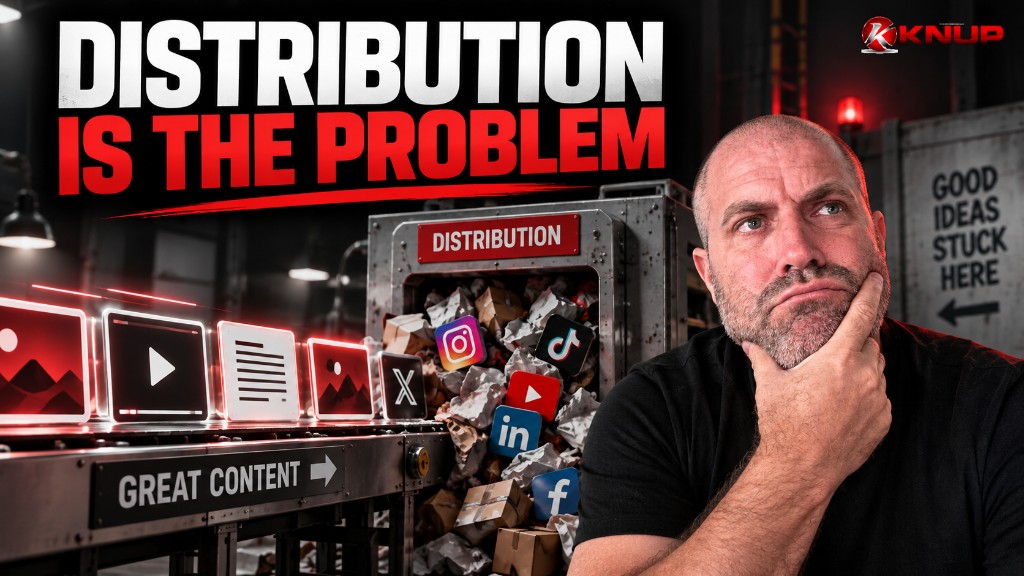
Most of my “business problems” look like product problems. They are usually distribution problems wearing a builder costume.
The site needs another page. The offer needs another tweak. The brand needs another logo pass. The project needs one more feature before anyone can see it. That work feels responsible. It also lets me avoid the harder question: who is going to find this, how often, and through what owned path?
Distribution is the problem. Not forever. Not for every company. For me, right now, across Knup and the ventures — yes.
Building feels like progress. Distribution feels like exposure.
Building is private. You can redesign a homepage at midnight and call it work. Nobody rejects you while you move pixels around.
Distribution is public. You have to show up where attention already lives. You have to repeat yourself. You have to ship something unfinished enough to invite a reaction. That is uncomfortable for builders. It is also the job.
I have about ten half-built projects on the hard drive. I wrote about that honestly in I Have About 10 Half-Built Projects and Almost None of Them Have Launched. The pattern is not only “I hate finishing.” It is also “I would rather invent the next thing than put the current thing in front of people every day.”
A project that never ships has perfect distribution — zero. No critique. No silence. No scoreboard.
What I mean by distribution
Distribution is not a vague buzzword. For me it is the system that repeatedly puts the right work in front of the right people.
- Channels you show up on with a rhythm
- Content that can travel without you rewriting it from scratch every time
- Paths that capture attention into owned contact
- Follow-up that turns interest into a next step
- A scoreboard that tracks reach and response, not only “I posted”
That is why posting is not marketing still matters. Posting can be one distribution motion. It is not the whole system. And restarting marketing every month is often what happens when distribution never gets boring enough to compound.
The lies I tell myself so I can keep building
- “Once it is ready, people will find it.” They will not. Discovery is a job.
- “I need a better product before I push it.” Sometimes true. Often a delay tactic.
- “I am bad at marketing.” Maybe. More often I am inconsistent at distribution.
- “Relationships will cover it.” Relationships help. They are not a full channel plan. See relationship-first businesses — trust compounds, but someone still has to keep showing up.
- “Traffic will fix it.” Traffic without a handoff is a vanity leak. That is why blogs get traffic but no leads.
Where this shows up in real Knup work
Sports 2.0 taught me that content at scale without distribution ownership is theater. We could produce. The harder layer was always getting pieces into the right lanes with owners and cadence — I covered that in What I Learned Running a Sports Content Network at Scale.
On X, I waited too long to treat the platform like a real distribution surface. LinkedIn worked. I treated that like either/or. The catch-up is distribution work, not another rebuild of the homepage — I Waited Too Long to Take X Seriously.
Across brands, the pain is the same. Ideal Homeschool, Sports Mentorship, Knup domains, Built by Knup — each can absorb endless product polish. None of them grow if the only plan is “ship something good and hope.”
Distribution needs a calendar you can keep
Multi-brand posting without a system turns into daily phone chaos. Schedule the lane. Then protect it.
Product problems vs distribution problems
A real product problem sounds like this: people arrive, understand the offer, and still bounce because the thing does not work or does not match the promise.
A distribution problem sounds like this: almost nobody arrives. Or the wrong people arrive. Or people arrive once and never hear from you again.
Lead generation feels hard for the same reason — attention is not a hand raise. I wrote about that in Why Lead Generation Feels Harder Than Marketing. Distribution sits upstream of that pain. If nobody sees the work, you will keep diagnosing the offer with no data.
What I fix before I build the next thing
Practical filter I am using now:
- Name the channel. One primary lane for the next 30 days. Not seven.
- Name the asset. What are you distributing — post, page, offer, episode, list?
- Name the cadence. Daily, three times a week, weekly. Write it down.
- Name the capture. Where does attention become a contact or a booked step?
- Name the follow-up. If they respond, what happens in 48 hours? Follow-up without being annoying is part of distribution, not a separate hobby.
- Repurpose before you invent. One strong piece should feed more than one surface — repurposing content is distribution leverage.
If I cannot answer those, I do not get to start another build thread. That is the deal I am trying to keep with myself.
Distribution is boring on purpose
The fantasy is a launch that explodes. The reality is a lane you protect when you are tired.
That is why restarting marketing feels exciting and maintaining distribution feels flat. Flat is where compounding lives. Tools help — I use Metricool when multi-brand scheduling is the bottleneck — but no tool replaces the decision to keep the lane longer than your enthusiasm.
Final thoughts
Distribution is the problem. Not because building is worthless. Building matters. Building without a path to people is a private hobby with invoices.
I am still a builder. I am just done letting the next feature pretend to be a growth plan. Fix the lane. Fix the capture. Fix the follow-up. Then earn the right to build the next thing.
Protect the lane — or wire the full system
Need scheduling across brands while you tighten distribution? Try Metricool. Want capture, CRM, and follow-up designed together? Start Built Discovery.