
I am not a golf instructor, and I am not going to pretend to be one. I am a regular golfer who usually lives somewhere between 95 and 100, and I wrote a whole post on how to break 100 in golf because that number is my world.
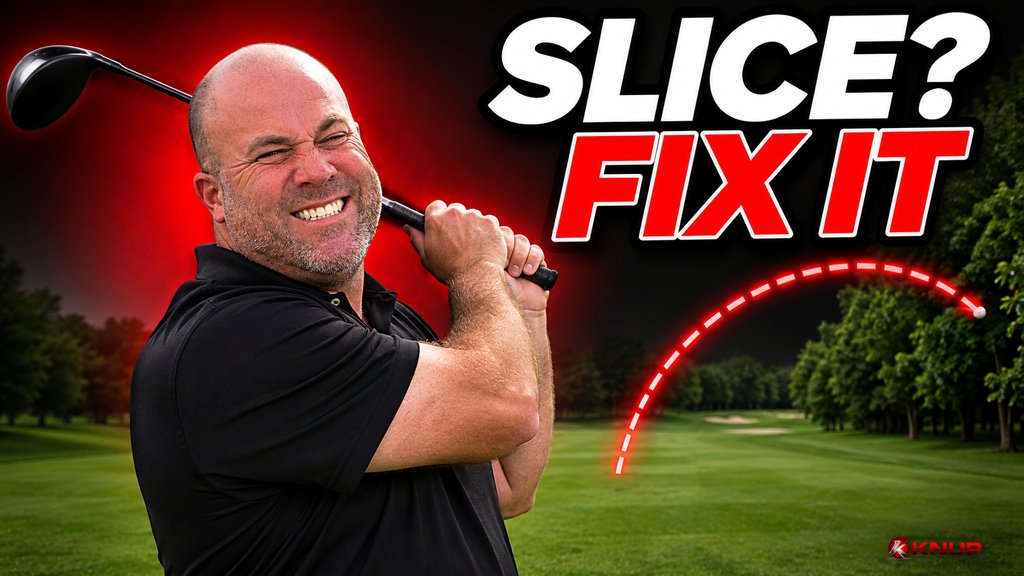
If you have spent time in that range, you know the shot. You aim down the middle, the ball starts left or straight, and then it peels off to the right like it has somewhere better to be. Trees, out of bounds, the next fairway over. That is a slice, and it is one of the most common misses in the game.
The good news is that a slice follows rules. Once you understand what is causing it, you stop guessing and start fixing. This post walks through the cause, the four fixes that matter most, a few drills, and how to play around it on the course while you work on it.
Quick note for lefties: everything here is flipped. Your slice curves left, and "right" becomes "left" throughout.
What causes a slice in golf
A slice comes down to two things happening at impact:
- The clubface is open to your swing path. The face is pointing right of the direction the club is traveling.
- The swing path is out-to-in. The club comes from outside the target line and cuts across the ball toward your body.
When the face is open to the path, the ball gets sidespin that curves it from left to right. The bigger the gap between where the face points and where the club is moving, the bigger the curve. GolfLink breaks it down the same way in this explainer on what causes a golf slice: an open face relative to the path, combined with an outside-to-inside path.
Here is why that matters. Most golfers try to fix a slice by swinging harder or aiming farther left. Neither one fixes the face or the path, so the slice stays. The real fix is getting the face more square and the path less out-to-in.
Start with your grip
If I could only change one thing for a slicer, it would be the grip. Your hands control the clubface, and a weak grip makes it very hard to get the face back to square at impact.
The PGA of America has a simple check in its piece on understanding how the clubface works. Look down at the back of your lead hand (the left hand for righties) at address and count the knuckles you see:
- One knuckle is a weak grip that tends to leave the face open and push the ball right.
- Two knuckles is closer to neutral.
- Three knuckles is a stronger grip that tends to close the face and pull the ball left.
If you slice and you only see one knuckle, rotate your lead hand a little to the right on the handle until you see two or three. Let your trail hand match it so the palms still face each other. It will feel strange at first. That is normal. Hit some balls with it before deciding it does not work.
Check your setup and alignment
A lot of slices are built before the club ever moves. Two setup habits cause trouble all the time.
Aiming left to "play the slice." It feels smart to aim left so the ball curves back toward the fairway. The problem is that aiming left encourages the exact cutting, out-to-in swing that made the slice in the first place. The PGA's five tips to fix your slice calls this out directly: aiming farther left can make the slice worse, and it costs you distance on every shot.
Instead, set up square. The PGA's clubface article suggests building your stance from the club, not your feet:
- Stand behind the ball and pick your target line.
- Walk in and set the clubface pointing down that line first.
- Set your trail foot, then your lead foot, so your feet, hips, and shoulders run parallel to that line.
Ball position. If the ball is too far back in your stance, you tend to hit it before the face has had time to square up, which leaves it open. If it is too far forward, the face can close. With a driver, the ball usually sits off the inside of your lead heel. With mid irons, closer to the middle. If you slice everything, check that the ball has not drifted back.
Fix the out-to-in swing path
This is the hardest part, and I will be honest about that. Changing your path takes reps. But understanding it is step one.
The out-to-in path usually starts at the top of the backswing. The shoulders and arms throw the club outward to start the downswing, often called "coming over the top," and the club cuts across the ball.
A few feels that help:
- Keep your trail elbow close to your side. The PGA's slice tips point out that when the trail elbow drifts away from your body on the way down, the clubhead swings out and comes across the ball. Feel that elbow stay connected to your side as you start down.
- Swing toward right field. For a righty, picture the ball going out toward the right side of the fairway (first base side, if you think in baseball). That feel encourages a more in-to-out path.
- Let the lower body start the downswing. If your shoulders fire first, the club goes over the top. Starting with a small shift of weight to the lead side gives the arms room to drop in.
Do not try all three at once. Pick one feel, hit a bucket with it, and see what the ball does.
Learn to release the club
Even with a better grip and path, some golfers hold the face open through impact because they are scared of hooking it. The face has to rotate closed through the hitting area for the ball to fly straight.
The PGA's article on how to hit the golf ball where you want describes a forearm issue that causes exactly this: rotating the forearms too late, or not at all, leaves the face open at impact. The fix is letting your forearms turn over naturally through the ball so the toe of the club passes the heel after impact.
A simple feel: at the finish of a half swing, the toe of the club should point up toward the sky, not back at you.
Drills to fix a slice
You do not need fancy gear. A few tees, an alignment stick or two, and your phone will do it.
The gate drill. The PGA's "hit it where you want" article suggests putting a tee on each side of the ball, a little wider than the ball, plus two more a few inches in front of it. Make small hip-to-hip swings and try to send the club through the gate with the face square. Work up to fuller swings once it feels natural.
The alignment stick check. Lay one stick on the ground pointing at your target and another along your toe line, parallel to the first. This keeps you honest about aiming left. The PGA also has a dedicated swing-station drill to help fix your slice using a pair of alignment rods to create an exaggerated feel of closing the face.
Film yourself down the line. Set your phone behind you, pointed down the target line, and record a few swings. Pause when the shaft is parallel to the ground on the downswing. If the clubhead is outside your hands, you are over the top. If it covers your hands, you are in a good spot. This is straight from the PGA's guide to hitting the ball where you want, and it is the most useful two minutes you can spend at the range.
Half swings first. Every drill above works better at half speed. A slice gets worse when you swing harder, so prove the new move slowly before you add speed.
How to play with a slice while you fix it
Swing changes take time. Meanwhile, you still have a tee time on Saturday. Here is how I would manage a round with a slice in the bag:
- Tee up on the right side of the tee box. That gives a slicer a little more fairway to work with because it angles you away from trouble on the right.
- Hit a club you can control. If the driver is slicing into the trees, a hybrid or fairway wood often curves less because it has more loft. Shorter and in play is better than long and lost. This is the same "make your tee shot boring" idea from my break 100 game plan.
- Do not fight it mid-round. The course is not the place for a full rebuild. Pick one simple thought, like grip pressure or trail elbow, and save the big work for the range.
- Track your misses. I keep score of everything, and a quick note on your scorecard or app about where each tee shot went tells you if the work is paying off. My post on how to keep score in golf covers a simple way to do it, and apps like 18Birdies make it easy to log fairways hit.
When to get a lesson or check your equipment
If you have worked on the grip, setup, and path for a few weeks and the slice is still there, get a lesson. A PGA coach can often spot what you might chase on your own for months. One lesson focused on just your slice is often worth more than a year of random range sessions.
Equipment can play a role too. A driver with very little loft, or shafts that do not fit your swing, can make it harder to square the face. A club fitting can tell you if your gear is part of the problem. But fix the fundamentals first. New clubs will not fix a weak grip.
A simple practice plan for your next range session
Here is how I would spend one bucket of balls:
- 10 balls checking your grip. Two to three knuckles on the lead hand. Hit easy 7-irons.
- 10 balls with alignment sticks down. Square setup, no aiming left.
- 20 balls with the gate drill. Half swings, then three-quarter swings.
- 10 balls filmed down the line. Check your clubhead position at shaft-parallel.
- The rest with your driver. Same grip, same setup, at 80 percent speed.
Then go play. Count how many tee shots stay in the fairway or first cut. That number is your scoreboard for the slice.
Final thoughts
A slice feels random, but it is not. It is an open clubface plus an out-to-in path, and both can be fixed. Start with the grip, set up square instead of aiming left, work on your path with one feel at a time, and let the club release.
You do not have to hit a pretty draw to score better. You just need the ball to stop running away from you. For a golfer in the 90s, that alone can be worth several strokes a round.
If you want more golf posts, check out my golf course reviews and the rest of the golf section here on the blog.
FAQ
What is the main cause of a slice in golf?
A slice is caused by the clubface being open relative to the swing path at impact, usually combined with an out-to-in swing path. That combination puts sidespin on the ball that curves it left to right for a right-handed golfer.
What is the fastest way to fix a slice?
For most golfers, the fastest improvement comes from strengthening the grip so you see two or three knuckles on your lead hand at address. A stronger grip makes it easier to square the clubface at impact.
Should I aim left to fix my slice?
No. Aiming left can encourage the same out-to-in swing that causes the slice. Set up square to your target and work on your grip and swing path instead.
Why do I slice my driver but not my irons?
The driver has the least loft of your full-swing clubs, so any open clubface creates more sidespin and more curve. Irons have more loft, which reduces curve. The driver is also the longest club, which makes it harder to square up.
Can new clubs fix a slice?
Equipment that fits your swing can help, but it rarely fixes a slice by itself. Grip, setup, and swing path are the root causes. Work on those first, then consider a club fitting.
Golf course reviews
If you like golf course breakdowns, I rate every course I play, with real rounds and scorecards, over in my golf course reviews.