
I keep score of everything. I wrote a whole post about it, I Keep Score of Everything Including Life, so you can guess how I feel about a golf scorecard. It is the one place where the number never lies.
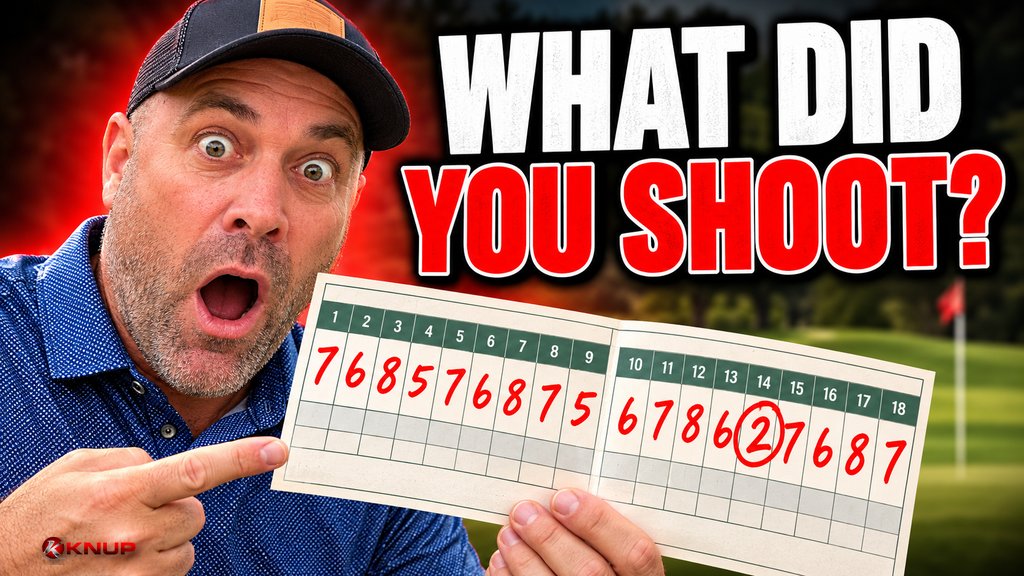
I am not a scratch golfer. My usual band is somewhere between 95 and 100. When I played Eagle Creek in Lake Nona, I shot a 98 from the yellow tees, 47 on the front and 51 on the back, with one birdie on a par 3. I tracked every hole, and I will use that round as the example below.
That is kind of the point. You do not need to be good to keep score the right way. You just need to know the rules. And most new golfers were never really taught them. They figured it out from whoever they played with, which is how you end up with "I think that was a 6?" on half the holes.
So here is how to keep score in golf, start to finish.
The basic rule: every stroke counts
Your score on a hole is the number of strokes it took you to get the ball from the tee into the cup, plus any penalty strokes.
That is the whole game. A stroke is any time you swing at the ball intending to hit it, so a few things people like to forget still count:
- Whiffs count. If you swing to hit it and miss completely, that is a stroke.
- Tap-ins count. A one-inch putt is still a putt.
- Every chip, punch-out, and bunker shot counts. The ugly ones too.
- Practice swings do not count, as long as you were not trying to hit the ball.
Add up your score on all 18 holes and that total is your gross score for the round. Lowest score wins.
How to read a golf scorecard
Grab a scorecard at the pro shop or in the cart before you tee off. They all look a little different, but the rows are pretty standard:
- Hole. Numbered 1 through 18. The front nine is often labeled "Out" and the back nine "In."
- Tee rows. One row per set of tees, showing the yardage of each hole from those tees. Pick the tees that fit your game, not your ego.
- Par. The number of strokes a good golfer is expected to need on that hole. Most holes are par 3, par 4, or par 5, and most 18-hole courses add up to a par somewhere around 70 to 72. Eagle Creek is a par 73.
- Handicap or stroke index. A ranking of the holes from 1 (hardest) to 18 (easiest). You will use this when you start figuring net scores and handicap adjustments.
- Blank rows. This is where you write each player's score.
At the end of the front nine, add up the "Out" total. At the end of the back nine, add up "In." Add the two together for your total. My round looked like this: 47 out, 51 in, 98 total.
Golf scoring terms: par, birdie, bogey and more
Once you know par for a hole, every score has a name based on how far over or under you are:
- Hole-in-one (ace): The ball goes in on your tee shot.
- Albatross (double eagle): 3 under par on a hole, like a 2 on a par 5.
- Eagle: 2 under par, like a 3 on a par 5.
- Birdie: 1 under par, like a 2 on a par 3.
- Par: Exactly par.
- Bogey: 1 over par.
- Double bogey: 2 over par.
- Triple bogey: 3 over par. After that, most people just say the number and move on quickly.
For the whole round, golfers usually describe the score relative to par. My 98 on a par-73 course was +25, or "25 over." If you shoot 70 on a par 72, you are "2 under."
A lot of people mark their card so they can see the round at a glance: circle a birdie, double-circle an eagle, put a square around a bogey, and a double square around a double bogey. You do not have to, but it makes the card fun to look at later. My birdie on Eagle Creek's par-3 eighth got a circle.
How to count penalty strokes
This is where most scorecards go wrong. Penalty strokes get added to your score on that hole, and the common ones are worth learning before your next round. Here is how they work under the Rules of Golf:
- Out of bounds or lost ball: 1 stroke, plus you replay from where you hit it. This is called stroke and distance. If you hit your tee shot out of bounds, you add a penalty stroke and hit again from the tee, so you are now hitting your third shot. A ball is lost if you do not find it within three minutes of starting to look. The full details are in Rule 18.
- Provisional ball. If you think your ball might be lost or out of bounds, you can hit a provisional ball right away so you do not have to walk back. You have to say clearly that it is a provisional. If you find the original in bounds, you play it and the provisional never counts.
- Penalty area (water or red/yellow stakes): 1 stroke. You take a drop under the relief options and add one stroke.
- Unplayable lie: 1 stroke. If your ball is stuck under a bush or against a tree, you can declare it unplayable, take a drop under the rules, and add one stroke.
- Wrong ball: 2 strokes in stroke play. Hit someone else's ball and you take two penalty strokes, then go play your own.
Some courses use a local rule that lets you drop near where your ball went out of bounds or got lost, for two penalty strokes, instead of walking back. It is a big pace-of-play saver for casual rounds. Check the scorecard or ask the pro shop whether it is in effect before you use it.
The R&A has a plain-English refresher on the lost ball and provisional rules that is worth five minutes of your time.
A quick example hole
Say you are on a par 4:
- Your tee shot goes out of bounds. That is 1 stroke, plus 1 penalty stroke.
- You re-tee and hit into the fairway. That is stroke 3.
- Your approach lands in a greenside bunker. Stroke 4.
- You blast out onto the green. Stroke 5.
- You two-putt. Strokes 6 and 7.
You write down a 7 on that hole. That is a triple bogey. It happens to everybody.
Gross score vs. net score
Your gross score is the actual number of strokes you took. Your net score is your gross score minus your handicap strokes. Net scoring is what lets a 98 shooter like me compete fairly with someone who shoots in the 70s.
To get a net score, you need a handicap. Under the World Handicap System, that works in a few layers:
- Handicap Index. A number that shows your ability. It is calculated from the best 8 of your most recent 20 rounds that you post.
- Course Handicap. Your Handicap Index adjusted for the specific course and tees you are playing, using the course's Slope Rating and Course Rating. Most golf apps and the course's own chart will figure this for you.
- Stroke index. If your Course Handicap is 15, you get one stroke on the 15 hardest holes, the ones ranked 1 through 15 on the card.
So on a hole where you get a stroke, a bogey becomes a net par. If you shoot 98 with a Course Handicap of 25, your net score is 73.
Max score per hole for handicap purposes
Here is the rule that saves your handicap from one disaster hole. When you post a score for your handicap, there is a cap on what you can count on any single hole.
Once you have an established Handicap Index, the most you can count on a hole is a net double bogey: par, plus 2, plus any handicap strokes you get on that hole. If you are on a par 4 and you get one stroke there, your max for handicap purposes is a 7. If you are still posting your first three scores to set up a handicap, the max is par plus 5. The USGA explains it on its maximum hole score FAQ.
Two things to remember:
- This is only for posting your handicap. In a tournament or a bet with your buddies, your real score counts unless the format says otherwise.
- Hole-by-hole posting does it for you. If you enter your round hole by hole in a posting app, the adjustment is applied automatically.
Other scoring formats you will run into
Stroke play, where you count every shot and add them up, is the default. But a lot of rounds, outings, and scrambles use a different format:
- Match play. You compete hole by hole. Lowest score on a hole wins that hole. The player who wins the most holes wins the match, so one blow-up hole only costs you one hole.
- Stableford. You earn points on each hole based on your net score: 0 for net double bogey or worse, 1 for net bogey, 2 for net par, 3 for net birdie, 4 for net eagle. Highest points total wins. It is great for higher handicaps because a bad hole just means zero points.
- Scramble. Common in charity outings. Everyone on the team hits, the team picks the best shot, and everyone plays from there. You keep one team score per hole.
- Best ball. Everyone plays their own ball, and the team counts the lowest score on each hole.
Use an app, but learn it on paper first
These days I track my rounds in 18Birdies. It keeps the hole-by-hole card, and I can look back at a round months later and see exactly where it went wrong. On that Eagle Creek round it showed me I had two other birdie looks and missed both, one short putt and one long one I left short. That is the kind of thing you forget by the parking lot.
Apps are great, but I would still learn to keep a paper card first. You will understand the numbers better, you will catch mistakes, and you will never be the person standing on the 18th green saying, "Wait, what did I get on 4?"
Scorekeeping etiquette that keeps the group moving
A few habits that make you a good playing partner:
- Write your score down at the next tee, not on the green. Clear the green so the group behind can hit, then record.
- Be honest with yourself. Count every stroke and every penalty. A score you fudged does not tell you anything.
- Know what a gimme is. In casual golf, friends often concede short putts. That is fine for fun, but it is not part of the official rules, so do not count gimmes when you are posting for a handicap or playing in a competition.
- Say your score out loud. When someone is keeping the card for the group, tell them your number and let them confirm it.
Final thoughts
Keeping score in golf comes down to one honest habit: count every swing, add every penalty, and write it down before you move on. Learn par and the scoring terms, know the handful of penalties that come up all the time, and figure out your net score once you have a handicap.
Do that, and your scorecard turns into something useful. It tells you where your strokes are actually going, which is the only way you get better. I am still chasing a round in the low 90s. When it happens, you will see it on the card.
If you like golf course breakdowns, I rate every course I play, with real rounds and scorecards, over in my golf course reviews.
FAQ
How do you keep score in golf for beginners?
Count every stroke it takes to get the ball from the tee into the hole on each hole, add any penalty strokes, and write that number on the scorecard. Add the front nine and back nine together for your total. The lowest score wins.
Does a missed swing count as a stroke in golf?
Yes. If you swing intending to hit the ball and miss it completely, that whiff counts as a stroke. Practice swings do not count as long as you were not trying to hit the ball.
How many strokes is the penalty for out of bounds?
Out of bounds or a lost ball is a one-stroke penalty, and you have to replay from where you hit the previous shot. So if your tee shot goes out of bounds, your next swing from the tee is your third stroke. Some courses use a local rule that lets you drop near where the ball went out for two penalty strokes instead.
What is the maximum score you can take on a hole?
In regular stroke play, there is no maximum; your real score counts. For handicap posting, the most you can count on a hole is a net double bogey (par plus 2 plus any handicap strokes you get on that hole), or par plus 5 while you are posting your first three scores.
What is the difference between gross and net score in golf?
Gross score is the actual number of strokes you took. Net score is your gross score minus your handicap strokes, which lets golfers of different skill levels compete fairly.
Golf course reviews
If you like golf course breakdowns, I rate every course I play, with real rounds and scorecards, over in my golf course reviews.