
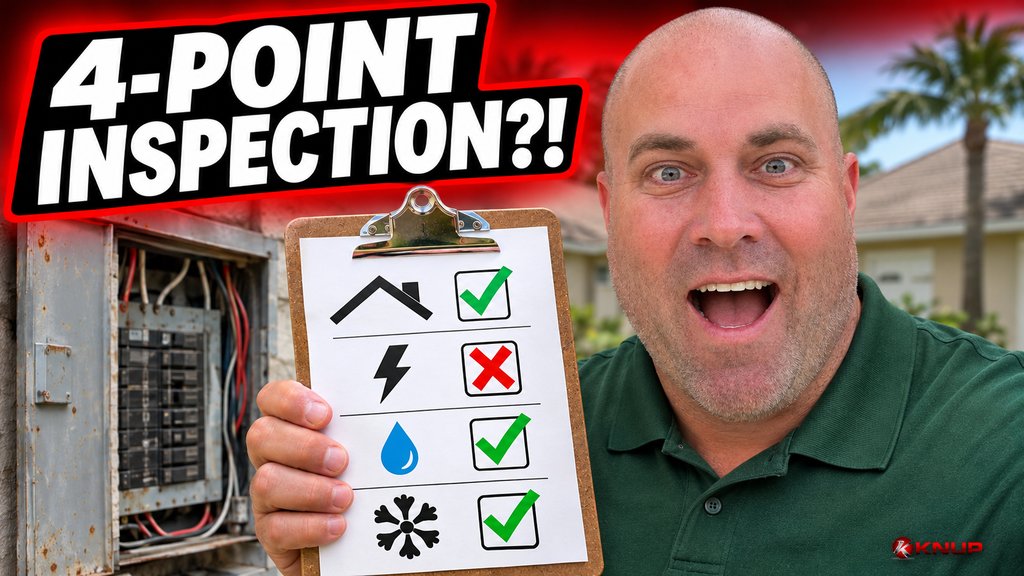
People moving to Florida hear "4-point inspection" for the first time and assume it's just another name for a home inspection. It isn't. A home inspection is for you. A 4-point inspection is for the insurance company.
That difference matters. A home inspection can find a hundred small things and the deal still closes. A 4-point inspection looks at four big systems, and if one of them makes the house hard to insure, you might not be able to get a policy. No policy usually means no mortgage, and no mortgage means no closing.
I got my Florida real estate license in 2026 with Florida Homes Realty & Mortgage, and I wrote the full buyer roadmap in How to Buy a House in Florida. The 4-point got a few paragraphs there. It deserves its own post, because it's one of the Florida-specific steps that surprises people the most.
Quick note before we start: I'm a Realtor, not an insurance agent, inspector or contractor. Every insurer sets its own rules, and those rules change. Use this to ask better questions, then get the final word from your insurance agent and a licensed inspector.
What is a 4-point inspection?
The Florida Department of Financial Services put out a plain-English four-point inspection guide with InterNACHI, the home inspector association. It describes a 4-point inspection as a specialized evaluation that Florida homeowners insurance companies commonly require when issuing or renewing a policy.
It looks at four systems:
- Roof
- Electrical
- Plumbing
- HVAC (heating, ventilation and air conditioning)
The guide says the main purpose is to assess the condition and safety of those four systems to determine whether the property is insurable. That's the whole point. It's not grading the house. It's answering one question for the insurer: are any of these four things likely to cause a big claim?
How it's different from a regular home inspection
A full home inspection walks through the entire property. Foundation, windows, doors, attic, appliances, grading, the works. You order it during your inspection period so you know what you're buying and can negotiate repairs.
A 4-point inspection is much narrower. It documents the age, type and condition of the roof, electrical, plumbing and HVAC, with photos, on a form the insurer can review. The DFS guide says a 4-point inspection done by a licensed professional should generally take about an hour.
Here's the practical part. A lot of Florida inspectors offer the 4-point (and the wind mitigation inspection) as add-ons to a full home inspection. If you're buying an older home, ask about bundling them so you get everything done in one visit during your inspection period.
Who needs a 4-point inspection in Florida?
There's no single state rule that says every home over a certain age needs one. It's an underwriting requirement, and each insurance company decides when it wants one.
The clearest public example is Citizens Property Insurance Corporation, Florida's state-created insurer. Its inspections page says Citizens requires a four-point inspection for all property owner, dwelling and mobile home applications for properties more than 20 years old. Citizens raised the bar in 2022, when it changed the rule from homes over 30 years old to homes over 20 years old.
Private insurers set their own age cutoffs and rules. Some ask for one on any home past a certain age. Some ask for one at renewal. Some may not ask at all. That's why the first call I'd make on an older home is to an insurance agent, before the inspection period runs out.
Common situations where you'll run into one:
- You're buying an older home and your new insurer wants a 4-point before it will quote or bind a policy.
- You're switching insurers on a home you already own.
- Your current insurer asks for one at renewal. The DFS guide notes 4-points come up for renewals as well as new policies.
What the inspector looks at
The DFS guide breaks it down system by system. Here's the plain version.
Roof
The inspector notes the roof's covering type, age, condition and any visible damage or deterioration, like curling, lifted or missing shingles or tiles, or signs of leaks. The report includes photos of each slope of the roof.
Roof age is the big one in Florida. The DFS guide gives an example: an insurer may want documentation of at least five years of remaining useful life for shingle roofs older than 15 years or tile and metal roofs older than 20 years.
Citizens uses its own cutoffs. Its inspections page says roofs older than 25 years for shingle and similar soft roofs, or 50 years for hard roofs like tile, slate, clay, concrete or metal, need documentation showing at least five years of remaining useful life. If the roof has less than five years left, Citizens wants proof of a full roof replacement before it will write a policy.
There's also a state law that helps here. Under section 627.7011 of the Florida Statutes, an insurer can't refuse to issue or renew a homeowners policy solely because of the age of a roof that's less than 15 years old. For a roof that's at least 15 years old, the insurer has to let the homeowner get a roof inspection by an authorized inspector, at the homeowner's expense, before requiring a replacement. If that inspection shows five years or more of useful life left, the insurer can't refuse to issue or renew solely because of roof age. The law applies to policies issued or renewed on or after July 1, 2022.
Notice the word "solely." Condition still matters. A roof with active leaks is a different conversation.
Electrical
The inspector looks at the panel, the wiring type and any safety hazards. The DFS guide calls out things like exposed wiring and outdated components.
The Citizens 4-point form gives a good picture of what insurers want to know. It asks for the panel's age, amperage and brand, and the wiring type, with checkboxes for things like knob and tube, cloth wiring and aluminum wiring. Its hazard list includes blowing fuses, tripping breakers, double taps, exposed wiring, empty sockets and improper grounding. If aluminum branch wiring has been fixed, Citizens wants separate documentation of that work certified by a licensed electrician.
Plumbing
The inspector records the water heater and its age, the pipe types, any leaks, and whether the home has been re-piped. The DFS guide specifically mentions noting whether the plumbing has been updated or re-piped.
Pipe material is what trips people up. The Citizens form has checkboxes for copper, PVC, galvanized and polybutylene, among others, plus active leaks, signs of past leaks, and leaking or cracked connections and hoses. Citizens' current March 2025 form requires a photo of the water heater that includes the temperature/pressure relief valve.
HVAC
The inspector notes the age and condition of the heating and cooling system and whether it's working. The DFS guide says the report should include a photo of the HVAC equipment with its dated manufacturer's plate. It also checks for wood-burning stoves or central gas fireplaces and whether they were professionally installed.
The photos
The DFS guide lists the photos a report should include: each side of the home, each slope of the roof, the water heater, under-cabinet plumbing and drains, exposed valves, the open electrical panel and its door, the HVAC equipment and its dated plate, and any hazards or deficiencies. The photos are how the underwriter checks the inspector's work without sending someone out.
How much does a 4-point inspection cost?
The DFS guide says that as a standalone service, a 4-point inspection may typically run $100 to $300. Price depends on the inspector, your area, the size of the home and whether it's bundled with a full home inspection or other services. The guide suggests getting quotes from several licensed inspectors to make sure the fee is in line.
Who pays? Usually whoever needs the policy. When you're buying, that's typically you, the buyer, since it's your insurance application. If the seller already has a recent 4-point, ask for a copy, but check whether your insurer will accept it before you skip ordering your own.
Who can do a 4-point inspection?
It has to be someone your insurer will accept, and it has to be a real, verifiable Florida license.
The DFS guide says the inspection must be completed and signed by a verifiable Florida-licensed professional, such as a general, residential or building contractor, or a home inspector. Citizens' list is a little broader and also includes a building code inspector, a registered architect, a professional engineer and certain building code officials. Citizens notes that trade-specific licensees can only sign off on their own trade, so a roofer can sign the roof section but not the electrical.
You can look up any Florida contractor or home inspector license on the Department of Business and Professional Regulation's site at MyFloridaLicense.com. It takes a minute and it's worth doing, because Citizens says a form may not be accepted if the inspector's license isn't active or can't be verified.
How long is a 4-point inspection good for?
It depends on the insurer.
The DFS guide says the report generally has to be dated within 30 days before the insurance application, but each insurance company decides what it will accept. Citizens' published answers say its 4-point report must be dated within the last 12 months before a new-business application.
Translation: don't assume an old report will work. Ask your insurance agent what date range they'll take before you order one.
What makes a home fail a 4-point inspection?
There's no official pass or fail grade. The inspector documents what's there, and the insurer decides whether it will write the policy, write it with conditions, or decline.
That said, these are the kinds of findings that tend to cause problems, based on what the DFS guide and the Citizens form focus on:
- An older roof without enough remaining useful life, or one with visible damage or leaks
- Electrical red flags like exposed or loose wiring, double taps, improper grounding, blowing fuses or tripping breakers
- Wiring types insurers ask about, like knob and tube, cloth wiring or aluminum branch wiring without documented repairs
- Plumbing issues like active leaks, signs of past leaks, or pipe types the insurer is wary of, such as polybutylene or galvanized
- HVAC that isn't working or a wood-burning stove or gas fireplace that wasn't professionally installed
Citizens is direct about it. Its inspections page says serious hazards or deficiencies, like exposed wiring or active leaks, should be repaired before an application for coverage is submitted. The DFS guide adds that homeowners may need to finish repairs before an insurer will issue a policy.
What to do if the 4-point finds a problem
Don't panic. You have options, especially if you find out during your inspection period.
- Call your insurance agent first. Ask exactly what the insurer needs to see. Sometimes it's a repair. Sometimes it's documentation, like a permit or an invoice showing a system was updated.
- Get a licensed pro to quote the fix. An electrician for the panel, a plumber for the pipes, a roofer for the roof. You want real numbers, not guesses.
- Shop other insurers. Underwriting rules vary from company to company. One may decline a home another will write.
- Negotiate with the seller. Depending on your contract, you may be able to ask for repairs, a credit or a price change. Your agent can tell you what your contract allows.
- Know your deadlines. If you can't get the home insured, talk to your agent and lender right away about your options under the contract.
If you're the seller, the same logic works in reverse. Getting a 4-point before you list an older home tells you what a buyer's insurer will see. I talk more about getting ahead of surprises in How to Prepare Your House to Sell in Florida.
4-point vs. wind mitigation inspection
These two get mentioned together a lot, so it helps to keep them straight.
- A 4-point inspection is about eligibility. Can the insurer cover this home at all based on the roof, electrical, plumbing and HVAC?
- A wind mitigation inspection is about discounts. It documents features that help the home hold up in a windstorm, like roof shape, roof-to-wall connections and opening protection.
The state's mitigation inspections page says a completed wind mitigation form is valid for up to five years as long as nothing material changes about the home. If you're already paying an inspector to come out, it usually makes sense to ask about doing both.
My simple 4-point game plan for buyers
If I were buying an older home in Florida, here's how I'd handle it:
- Before or right after the offer, call an insurance agent and ask whether they'll require a 4-point, what date range they accept and what their roof rules are.
- Ask the seller for any recent 4-point, wind mitigation or roof inspection, plus permits for roof, electrical, plumbing or HVAC work.
- Book the full home inspection, 4-point and wind mitigation together, with a licensed inspector you've looked up on MyFloridaLicense.com.
- Send the 4-point to your insurance agent the day you get it and get real quotes during the inspection period.
- If something comes back ugly, get repair quotes and talk to your agent about your options before the inspection period ends.
The goal is simple: find out whether the house is insurable while you still have leverage, not the week before closing.
Final thoughts
A 4-point inspection is short, cheap compared to the price of a house, and very important in Florida. It looks at the roof, electrical, plumbing and HVAC so an insurer can decide whether to cover the home. On an older home, it can be the difference between a smooth closing and a scramble.
Ask your insurance agent early, hire a licensed inspector, and treat the results as information you can act on. If you're buying in Central Florida and want someone to walk you through it, you can find me on my Florida Realtor page. And once you close, don't forget the next Florida step: How to File for Homestead Exemption in Florida.
FAQ
What is a 4-point inspection in Florida?
It's a limited inspection of a home's roof, electrical, plumbing and HVAC systems that Florida homeowners insurers commonly require when writing or renewing a policy. It documents the age, type and condition of each system, with photos, so the insurer can decide whether the home is insurable.
How old does a house have to be to need a 4-point inspection?
It depends on the insurer. Citizens Property Insurance requires one for homes more than 20 years old on new applications. Private insurers set their own age cutoffs, so ask your insurance agent.
How much does a 4-point inspection cost in Florida?
The Florida Department of Financial Services' guide says a standalone 4-point may typically cost $100 to $300. It may be cheaper as part of a package with a full home inspection.
Who pays for the 4-point inspection when buying a house?
Usually the buyer, because it's part of the buyer's insurance application. A seller may already have a recent report, but check whether your insurer will accept it.
How long is a 4-point inspection good for?
Each insurer decides. The DFS guide says reports generally need to be dated within 30 days of the insurance application, while Citizens' published answers say its 4-point report must be dated within the last 12 months before a new-business application.
Can you fail a 4-point inspection?
There's no official pass or fail. The inspector documents conditions and the insurer decides. Findings like an old roof without enough remaining life, exposed wiring, active leaks or certain wiring and pipe types can lead an insurer to require repairs or decline coverage.
Is a 4-point inspection the same as a wind mitigation inspection?
No. A 4-point checks whether the home is insurable. A wind mitigation inspection documents wind-resistant features that may qualify you for insurance discounts. Many inspectors offer both.
Buying or moving in Central Florida?
I help buyers and sellers think through costs like homestead and property taxes. Start on my real estate page or book a real estate discovery call.